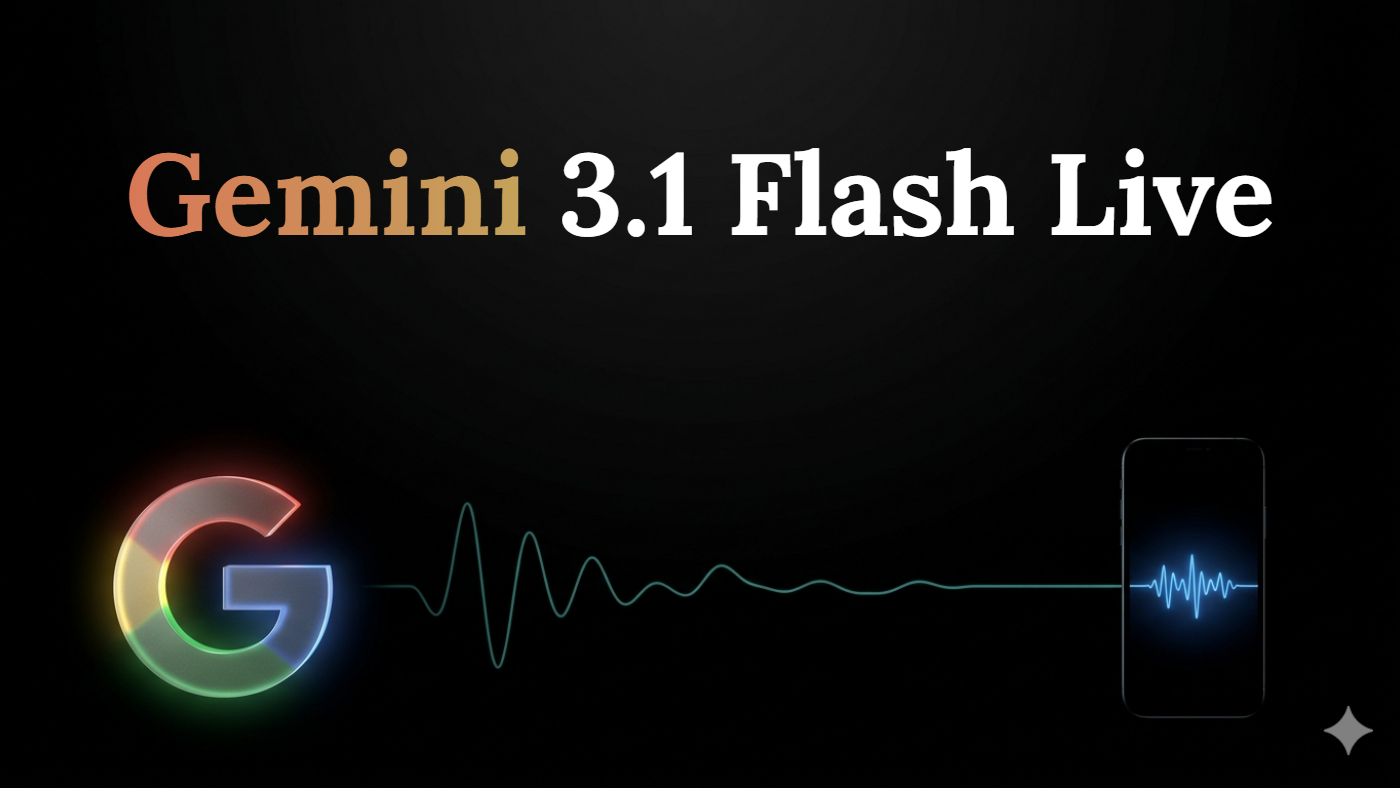
On March 26, 2026, Google shipped Gemini 3.1 Flash Live — a new model built specifically for real-time voice and vision agents. It’s available right now through the Gemini Live API in Google AI Studio, and it matters for anyone interested in vibecoding.
Here’s why: until now, building something that talks back to you — a voice assistant, a conversational app, an AI companion — required stitching together multiple services, managing latency, and writing a lot of glue code. Gemini 3.1 Flash Live collapses much of that into a single model that handles real-time audio and video natively.
If you’ve been vibecoding your way through web apps and simple tools, this opens up an entirely new category of things you can build.
What Gemini 3.1 Flash Live Actually Does
The model is designed for one thing: real-time conversation. Not “generate a response and read it aloud” — actual back-and-forth dialogue at the speed of a normal human conversation.
Google is positioning this as a step change in three areas: latency, reliability, and natural-sounding dialogue. The specifics matter.
Background noise filtering. The model can distinguish your voice from environmental sounds — traffic, a TV playing, other people talking nearby. Previous models struggled with this, often triggering tool calls or responding to background noise as if it were an instruction. Flash Live filters that out much more effectively.
Instruction-following under pressure. If you give the model a system prompt — say, “You are a customer service agent for a pet store, only answer questions about pet supplies” — it sticks to it. Even when the conversation goes sideways, the model stays within the guardrails you set. This was a known weak point in earlier real-time models.
Natural dialogue flow. The model recognizes acoustic nuances like pitch, pace, and emphasis. It understands not just what you’re saying, but how you’re saying it. The result is responses that feel conversational rather than robotic.
Multilingual support. Over 90 languages for real-time multimodal conversations. That’s not just text translation — it’s voice-in, voice-out across languages in real time.
Why This Matters for Vibecoding
If you’re building with AI tools and natural language — which is what vibecoding is — voice is the next frontier. Until now, vibecoding mostly meant typing prompts and getting code, text, or interfaces back. Gemini 3.1 Flash Live makes it possible to vibecode apps where the interface itself is a conversation.
Think about what becomes possible: an AI tutor that actually listens and responds in real time. A customer support agent that handles calls without awkward pauses. A game master for tabletop RPGs that speaks in character. A companion device for elderly users that can chat naturally in their native language.
These aren’t hypothetical. Google highlighted real apps already using the model at launch — including Stitch (voice-driven design on a canvas), Ato (an AI companion for older adults), and Wit’s End (a tabletop RPG with a voice-acted AI game master).
How Hard Is It to Get Started?
This is where it gets interesting for vibecoding. The basic setup is surprisingly simple. Here’s the core of what a connection looks like with Google’s Python SDK:
import asyncio
from google import genai

client = genai.Client(api_key="YOUR_API_KEY")

model = "gemini-3.1-flash-live-preview"
config = {"response_modalities": ["AUDIO"]}

async def main():
    async with client.aio.live.connect(model=model, config=config) as session:
        print("Session started")
        # Send audio, get audio back

if __name__ == "__main__":
    asyncio.run(main())
That’s a working connection to a real-time voice model in about ten lines of Python. Obviously, a production app needs more — handling audio streams, managing sessions, integrating tools — but the barrier to entry is dramatically lower than it was even six months ago.
The Live API also supports function calling during conversations, session management for long-running dialogues, and ephemeral tokens for secure client-side connections.
The Bigger Picture
This launch fits into a pattern we’ve been watching throughout 2025 and 2026: AI models are getting multimodal fast. Text-only was the starting point. Then came vision. Now real-time voice and video are becoming first-class capabilities.
For vibecoding, this means the definition of “what you can build without traditional coding skills” keeps expanding. A year ago, vibecoding meant generating a web app from a prompt. Today, you could describe a voice-first experience and have AI help you build it.
The catch — and there’s always a catch — is that real-time voice apps are inherently more complex than static web pages. Audio streams, WebRTC connections, latency management, and conversation state all add layers that a simple text prompt might not fully handle. You’ll still need to understand what you’re building at a high level, test the output, and iterate.
But the tools are meeting you more than halfway. And that gap between “I have an idea” and “I have a working prototype” keeps getting smaller.
What to Watch
Google mentioned partner integrations for WebRTC scaling and global edge routing — signals that they’re thinking about production-grade deployments, not just demos. The model is available through the Gemini API and Google AI Studio starting now.
If you’ve been vibecoding with text-based tools like Claude Code, this doesn’t replace that workflow. It adds a new dimension to it. The voice-first apps that were impossible for solo builders a year ago are now within reach.
The question isn’t whether AI voice agents will become mainstream. It’s how quickly the tools will get good enough that anyone — technical or not — can build one that actually works.
This blog post is part of the free vibe.lab course on vibecoding. Start from Chapter 1 to learn the full workflow.